

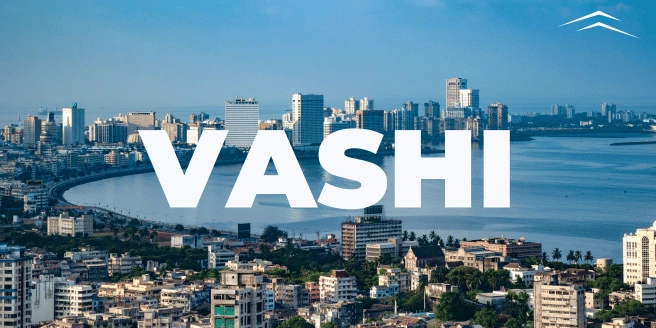
Every Navi Mumbai node gets measured against Vashi. Kharghar is “the new Vashi”. Ulwe will be “the next Vashi”. Nobody ever says Vashi is the next anything.
That’s because it already arrived. Vashi was Navi Mumbai’s first real town. The station, the market, the malls and the hospitals came here first, and families have been settled here for decades.
So if you’re looking at Vashi now, you’re probably feeling two things at once. It feels safe, proven, the “right” address. And the prices make you wonder whether you’re paying for a name built thirty years ago.
Maybe you grew up here and want to come back. Maybe your parents live in a CIDCO building in Sector 9 and you want to be close. Or maybe you’re moving from Mumbai and Vashi is the one Navi Mumbai name you trust.
Whatever brought you here, I’m not going to sell you Vashi. I’ll do what I’d do for a friend. Walk you through what it costs, sector by sector, how the old buildings are changing, what daily life really feels like, and how to tell whether it’s right for you.
Short answer
Vashi is Navi Mumbai’s most established node, and one of its most expensive. Across the new projects on our books, a two-bedroom asks a median ₹34,677 per sq.ft of carpet area, about double Kharghar. A typical new 2 BHK costs around ₹2.18 crore.
You pay for a complete town: two rail lines, the Thane Creek bridges, big hospitals, malls and markets, all already built. The trade-offs are older buildings, thin rental yields of roughly 3%, and a redevelopment wave that is reshaping the old CIDCO sectors one society at a time.
Vashi at a glance
Vashi sits at the Mumbai end of Navi Mumbai, right where the Thane Creek bridges land. It’s run by the Navi Mumbai Municipal Corporation, not CIDCO. That matters for things like water supply and civic services.
It’s on both the Harbour line to Mumbai and the Trans-Harbour line to Thane. The commercial heart is around Sector 17, and the station area around Sector 30A holds the big malls. Palm Beach Road runs south toward Nerul and Belapur.
Most of Vashi was built by CIDCO in the 1970s, 80s and 90s. Low-rise housing societies, wide internal roads, lots of trees. Today those old buildings are the story. Many are now more than thirty years old, and redevelopment is changing the skyline.
What Vashi costs in 2026
Here’s Vashi against the nodes people usually compare it with. Same method for each: the median new two-bedroom asking rate per square foot of carpet, from projects on our books.
Vashi tops the table. A new two-bedroom costs about 13% more per foot than in Sanpada next door, and nearly double Kharghar.
Outside data agrees on the level. 99acres pages put Vashi at roughly ₹31,500–32,500 per sq.ft carpet. New launches run from about ₹26,000 a foot to well over ₹40,000 for sea-facing towers.
Two warnings when you read any Vashi number. First, check the basis. Our figures are carpet area, the basis RERA agreements use. Portal averages on built-up area can look 15–30% lower for the same flat.
Second, new and resale are different markets here. An old CIDCO flat in a 35-year-old building trades far below a new tower. But part of what you’re buying is a stake in its future redevelopment. More on that below.
What ₹2.18 crore buys you here and next door
Rates per foot are hard to feel. Rooms are easy. So take the typical Vashi budget and see how far it goes.
In Vashi, ₹2.18 crore buys about 629 sq.ft of carpet. That’s a compact two-bedroom.
Move one station to Sanpada or Seawoods, and you get 715 to 726 sq.ft. A little more room to breathe.
In Nerul, it’s about 815 sq.ft. In Kharghar, about 1,242. That’s a three-bedroom.
So the real question isn’t whether Vashi is expensive. It is. The question is whether what Vashi gives you is worth those missing square feet. For some families, it clearly is. For others, a bigger home one node away changes daily life more.
The sector belts you need to know
Vashi isn’t one market. The sector you pick changes the price, the building age and the daily feel. Here’s the simple version.
Sector 9 / Juhu Nagar
The busiest redevelopment belt. Many new towers, including sea-facing launches. Expect the top of the Vashi price range.
Sector 10 and nearby
The original high-rise belt. Older stock mixed with new, and close to the main hospital cluster.
Sector 17 and around
Shops, offices, the central business district. Convenient, busy and noisy in the day.
Sector 18 and the edges
Smaller flats and the lower end of new-launch prices. The best entry point into the Vashi name.
For a project-by-project walk through each belt, read our sector-wise guide to the best 2 BHK projects in Vashi. It covers nine projects, belt by belt, with all-in costs.
The redevelopment wave in Vashi’s old CIDCO sectors
This is the biggest change in Vashi right now, and it affects almost every buyer here.
CIDCO built most of Vashi’s housing between the mid-1970s and the mid-1990s. Many of those buildings are now more than thirty years old, which makes them eligible for redevelopment. In February 2026, 28 redevelopment proposals were underway across NMMC, with 10 of them in Vashi. Sector 9 is the most prominent cluster.
What made the numbers work is extra building rights. Under the state’s UDCPR 2020 rules, first-built CIDCO buildings are reported to get 35% incentive FSI, plus another 10% for larger plots. More floor area means a developer can rebuild your society, give members bigger flats, and still sell extra units.
The state has also tightened the process. Under revised Section 79A guidelines, a redevelopment decision needs a two-thirds quorum and approval from at least 51% of all members. The developer must finish within two years of the first foundation or plinth certificate, extendable to three years only in exceptional cases.
So what does this mean for you?
If you’re buying an old CIDCO flat, you’re partly buying a future. A building heading for redevelopment can deliver a bigger, newer flat years from now. But nothing is certain until members vote and a developer signs. Ask the society secretary where they really stand.
If you’re buying a new flat in a redeveloped tower, check who the developer is and how many of the existing members have been rehoused already. A redevelopment that stalls hurts the old members and the new buyers alike. Ask which other society redevelopments this developer has finished in Navi Mumbai, then go and see one. Talk to a member who moved back in.
If you’re a member of an old society, know your rights under the new rules before anyone shows you a glossy offer. The 51% approval and the two-year deadline are there to protect you.
Resale or new: two different Vashis
Most buyers here end up choosing between an old CIDCO flat and a new tower. They feel like two different towns.
Old CIDCO resale. Lower price per foot. Wider roads, mature trees, established neighbours. You can move in now. But expect older plumbing, small lifts or none, and limited parking. Your upside is the redevelopment story, if your society gets there.
New tower. Higher price per foot. Lifts, parking, security, amenities, a clean MahaRERA record. But you may wait for possession, and you’re paying full price for the newness on day one.
Neither is the smart choice by default. If you need to move in this year and like the old Vashi feel, resale makes sense. If you want a modern building and can wait, new makes sense.
Just don’t mix the two in your head. A resale rate and a new-launch rate are not comparable numbers.
Getting around from Vashi
Connectivity is Vashi’s quiet superpower. Most of it is already built, not promised.
Rail. Vashi station is on the Harbour line into Mumbai and the Trans-Harbour line to Thane. Few Navi Mumbai nodes have both.
Road. The Thane Creek bridges land right here. The third bridge became fully open to traffic in June 2025, easing the Mumbai crossing. Palm Beach Road gives you a fast run south to Nerul, Seawoods and Belapur.
What’s only planned. A metro line linking Mumbai airport to Navi Mumbai airport, with a proposed Vashi station, was reported approved by the state cabinet in January 2026. It isn’t under construction yet. Treat it as a long-term maybe, not a reason to pay more today.
For airport travel, the international flight shift to Navi Mumbai airport has been delayed to 2027. Vashi sits between both airports, which is useful whichever way it goes.
What daily life in Vashi feels like
This is where Vashi earns its price. Everything is close.
Big hospitals are within a short drive. The malls, the markets and the station are a few minutes apart. Schools, coaching classes, banks, temples, gyms: you rarely need to leave the node for anything.
For a family with young kids, that means fewer long drives. For older parents, it means a doctor, a pharmacy and a friendly neighbour nearby. That’s worth more than any amenity list in a new township.
Picture a normal Saturday. Vegetables from the local market in the morning. A doctor’s appointment ten minutes away. Lunch at the mall. An evening walk on a tree-lined internal road. No long drive anywhere.
That’s the Vashi premium in one day. You aren’t paying for a view. You’re paying for short distances.
The flip side is age and traffic. Older buildings can have smaller lifts, limited parking and leaky plumbing. The roads around the CBD and the APMC market get crowded at peak hours.
Water deserves a mention this year too. Vashi is supplied by NMMC from Morbe dam, which fell to a ten-year low in October. Read what to check about water before you buy, especially in older buildings with small tanks.
New projects in Vashi worth a look
I checked the MahaRERA registration of every Vashi project on our books on 4 November 2026. One had filed for an extension. One registration number on our listing didn’t match MahaRERA’s records, so I’ve left it out until we fix it.
Here are four that show the range. Prices are asking prices from our listings.
10 Marina Bay by EV Group lists a 607 sq.ft two-bedroom from about ₹2.00 crore, around ₹32,949 a foot. It’s registered as P51700028722.
Akshar Panchratna by Akshar Developers lists a 745 sq.ft two-bedroom from about ₹2.18 crore, around ₹29,262 a foot. Registered as P51700051580. That’s more carpet for the money than most new Vashi launches.
Goodwill Wisteria by Goodwill Developers is 100% complete, with three-bedrooms from about ₹3.51 crore for 1,169 sq.ft. Registered as P51700052581. Useful if you want to move in without a construction wait.
The Gateway by Metricon Realty lists three-bedrooms from about ₹3.60 crore for 886 sq.ft, around ₹40,632 a foot. Registered as P51700050451. This is the premium end.
To see everything for sale in one place, browse property for sale in Vashi. For an honest take on the Vashi NX launch, read our Raheja Solaris and Lunaris review.
Is Vashi overpriced?
It’s the most expensive node on our list. That’s not the same as overpriced.
You’re paying for something the newer nodes can only promise: a finished town. If you’ll live here for years and use what it offers, the premium buys real hours back every week.
If you’re buying purely to rent out, the math is thinner. Gross rental yields in Vashi sit around 3%, low for the price. There are better yield plays elsewhere in Navi Mumbai.
I’ve written the full decision guide with five simple tools in Is Vashi overpriced? Use it once you’ve shortlisted a flat.
Who Vashi isn’t right for
I’d rather lose a sale than see you in the wrong flat. So here’s who should probably look elsewhere.
Families who need space above all. If a third bedroom or a study matters more than short drives, the same budget goes much further in Nerul or Kharghar.
Pure yield investors. Around 3% gross is thin. You’re buying stability and resale, not income.
Buyers who want a brand-new township. Vashi is an old town being rebuilt in pieces. If you want a gated campus with a clubhouse and a private park, the newer nodes do that better.
People who hate city bustle. The CBD, the market and the station keep Vashi busy. Some love that energy. Some find it tiring.
If you saw yourself in this list, that’s useful. It means your money can work harder somewhere else. And if you didn’t, Vashi may be exactly the right fit.
Which buyer are you?
Grew up here, or parents nearby
Vashi is hard to beat. Look at redeveloped towers near your family, and value being minutes away over a few extra square feet.
Want the safest Navi Mumbai name
Vashi gives you two rail lines and the shortest bridge crossing. Compare with Sanpada and Nerul before you commit.
Buying for rent
Yields near 3% are thin. Buy only if you’re happy with slow, steady appreciation and easy resale.
Need a bigger home
The same ₹2.18 crore buys far more carpet in Kharghar or Nerul. Weigh the daily commute honestly.
Notice the two voices in your head. One says Vashi is proven, so it can’t be a mistake. The other says why pay double for an older town. Both are shortcuts. The real test is simple. Will you use what Vashi gives you, every week, for years?
Mistakes I see Vashi buyers make
Buying the name, not the building. “It’s Vashi” isn’t a reason. A tired building in a great node is still a tired building.
Comparing resale and new rates. An old CIDCO flat and a new tower are priced on different logic. Compare like with like.
Counting on redevelopment that hasn’t been voted. Talk is cheap. Minutes, votes and a signed developer are what count.
Ignoring parking. In older sectors, one car slot can matter more than an extra 50 sq.ft inside.
Stretching for the address. If Vashi only works at the very top of your budget, a node next door may give your family a calmer life.
Five checks before you buy in Vashi
- Carpet or built-up? Get the carpet area in writing and work out the rate per foot yourself.
- Building age and redevelopment status. For any old CIDCO building, ask the society where its redevelopment stands and read the minutes.
- The MahaRERA page for your wing. For new towers, read the Extension Certificate field and the current completion date.
- Parking and lifts. Older buildings often have too little of both. Check before you fall in love with the layout.
- Peak-hour traffic. Drive from the building to your office at 9 on a weekday. Around the CBD and APMC, it can surprise you.
Every week someone asks me whether Vashi is still worth it. My answer is always a question back. What will you use here that you can’t get in a cheaper node? If you can name it, Vashi probably is worth it for you.
For prices across every node, see our Navi Mumbai property rates guide. If Vashi stretches the budget, read whether Nerul is overpriced. And before you take a loan, check what the October rate hike does to your EMI.
Questions people are asking me
What is the property rate in Vashi per sq.ft?
How much does a 2 BHK cost in Vashi?
Is Vashi a good place to live?
Is Vashi more expensive than Kharghar?
Which old buildings in Vashi are being redeveloped?
Is Vashi good for rental investment?
Is there a metro in Vashi?
Vashi is where Navi Mumbai began. For a lot of families, it’s still where life feels easiest. If that’s what you’re looking for, the premium is buying you something real.
If you’ve shortlisted a Vashi flat, new or old, send it over. Let’s walk through the price, the building and the paperwork together, before you sign.
Rates are medians of Revaa Homes project inventory, carpet-area basis, November 2026. Registration status checked on MahaRERA on 4 November 2026. Prices are asking prices from our listings; confirm the current cost sheet before booking.

