

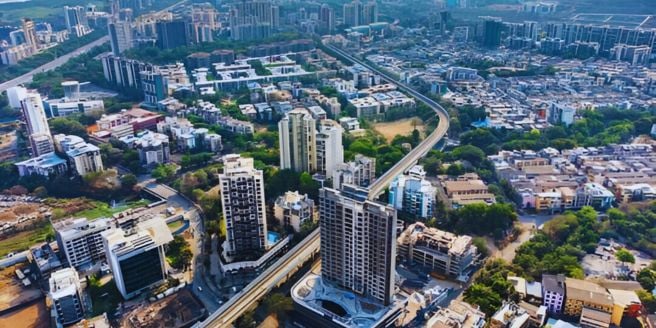
Someone told you Kharghar has become expensive.
Maybe a relative who bought here in 2015 for a third of today’s rate. Maybe a colleague who just paid ₹1.6 crore for a two-bedroom and is still deciding how he feels about it.
So you’re standing at the edge of a decision, and the number in front of you looks big. It usually does.
And underneath it sits the thing nobody says out loud. What if I pay this, and in three years I find out everyone else got the same flat for less?
That fear is reasonable. It’s also answerable, because the numbers exist.
I’ve shown flats across Navi Mumbai long enough to know that “expensive” is almost never the real question. Expensive compared to what is.
So I ran Kharghar against every other node on my books. The answer surprised me.
Short answer
No. Kharghar is not overpriced in 2026. Across 75 two-bedroom projects on my books, the median is ₹17,584 per sq.ft carpet.
That puts it sixth of nine Navi Mumbai nodes. Vashi, Sanpada, Seawoods, Nerul and Juinagar all cost more — Vashi almost double.
But the honest version has a second half.
Individual projects inside Kharghar absolutely can be overpriced, and the spread is wider than most buyers realise. The node is fair. Some flats in it are not.
Kharghar against the rest of Navi Mumbai
Here is every node where I have at least six two-bedroom projects, ranked by median rate per square foot of carpet.
Kharghar sits in the lower half. Not the cheapest, nowhere near the dearest.
Look at the gap to Nerul. A two-bedroom in Nerul asks about 51% more per foot than the same thing in Kharghar. Vashi asks nearly double.
If Kharghar felt expensive to you, it’s worth asking what you were comparing it against. Against Taloja or Panvel, yes, it costs more. Against the western seafront nodes, it’s a discount.
The number that confuses everyone
Now the part that causes most of the arguments.
Search for Kharghar rates and you’ll see ₹11,000 to ₹18,000 a square foot. My median says ₹17,584. Those look like different planets. They aren’t.
Portals usually quote saleable area. I quote carpet — the floor you can actually walk on, which is what RERA requires on your agreement.
Carpet is typically 60–70% of saleable. Run the conversion and ₹17,584 carpet lands at roughly ₹10,550 to ₹12,300 saleable.
Same node. Same flats. Two numbers that differ by 40%.
This is the single most useful habit you can build. Before comparing any two projects, ask which area the rate is quoted on. If the answer is vague, assume saleable and ask again.
Where Kharghar actually is overpriced
Here’s the part a broker isn’t supposed to write down.
The cheapest two-bedroom on my Kharghar list works out to ₹8,092 a foot. The dearest is ₹34,483. That’s a 4.3× spread inside one node.
Half of everything sits between ₹14,542 and ₹19,747. That band is the real Kharghar.
Above roughly ₹25,000 a foot, you are no longer paying for Kharghar. You’re paying for a brand, a plot, or a view — and those can be worth it, but you should know that’s the trade you’re making.
Only two projects on my entire Kharghar list cross ₹30,000. When a flat is priced there, the question stops being “is Kharghar overpriced” and becomes “is this flat worth 75% more than its neighbours”.
Sometimes the answer is yes. Ask it anyway.
Upper Kharghar is a different market
One more thing that skews comparisons badly.
“Upper Kharghar” is a marketing term, not a CIDCO node or a MahaRERA designation. The projects sold under that label run a median of ₹12,132 a foot — about 31% below core Kharghar.
That’s not a bargain or a trap. It’s a different location with different travel times, and it deserves its own comparison rather than being averaged in.
If a listing shows you a Kharghar-level price on an Upper Kharghar address, that gap is the whole conversation.
When it’s still worth paying
So what are you actually buying at ₹17,000-odd a foot?
A node that already works
Kharghar isn’t a promise. The metro runs. The hills are there. Schools, hospitals and the golf course exist today, not in a brochure.
Compare that with paying less in a node where the social infrastructure is still a plan. That difference is what your premium buys.
Two infrastructure projects that are actually being built
The Kharghar–Turbhe link road is under construction — both tunnel breakthroughs landed on 29 June and 31 August 2026, with completion now reported for December 2028. CIDCO’s international corporate park has completed its first phase of land auctions.
Neither is finished. Both are past the announcement stage, which is more than most Navi Mumbai infrastructure stories can claim.
Supply you can negotiate against
Seventy-five two-bedroom projects in one node is a lot of competition. That’s leverage.
In a thin market you take the price you’re given. In Kharghar you can walk to the next tower, and the sales desk knows it.
Before the “prices are rising” line lands
You will hear it on every site visit. Book today, sir, the rate revises next month.
Sometimes true. Often a closing line.
Here’s the rule I’d give a friend. A 2–3% revision on a ₹1.5 crore flat is about ₹4 lakh. Picking the wrong project costs far more than that, and you can’t undo it.
Never let a rate revision compress your diligence. If the price genuinely moves before you’re ready, that flat wasn’t yours.
Four questions to ask on your next site visit
If you take one thing from this page, take these. They cost you nothing and they change what you pay.
- Is that rate carpet or saleable? You now know the gap is around 40%. If the answer is vague, treat it as saleable and ask for the carpet rate in writing.
- What did the last three flats here actually close at? Not the list price — what people paid. Check any answer against registered values on the Maharashtra registration department portal.
- Where does this project sit against ₹17,584? Ask them to justify anything meaningfully above the median. Listen for whether the reason is about your life or their brochure.
- What is the all-inclusive number? Your rate is not your cost. Add GST, stamp duty, registration, floor rise, parking and club charges. Ask for one figure with everything in it.
You will feel awkward asking. Ask anyway. The people who get the best price in Kharghar are not the best negotiators — they are the ones who asked the boring questions first.
What a Tuesday actually looks like
Rates decide whether you can buy. Daily life decides whether you stay.
Kharghar is spread out. Sector to sector, distances are real, and an auto ride you assumed was five minutes is often fifteen. Walk the stretch between your tower and the nearest market before you commit.
School choice is genuinely good here, better than most Navi Mumbai nodes. Still drive the 8am route in traffic. Map distance lies on a weekday.
The hills are the thing residents actually love. Monsoon here is beautiful in a way no brochure captures. It also means humidity, and seepage in older buildings.
And the 2am question. A parent with chest pain, a child with fever — Kharghar does better than most nodes on hospitals, but know which one you’d drive to and how long it takes at night.
Who Kharghar suits
Priced out of Nerul or Vashi
A working node at roughly two-thirds the rate. This is the trade Kharghar exists to offer.
Wants infrastructure standing today
Metro, schools, hospitals, hills. Not announcements.
Willing to negotiate
75 competing projects in one node is the strongest position a buyer can hold.
Budget stops near ₹1 crore
At the median that buys a compact 2 BHK. Panvel or Taloja may fit you better.
Daily Mumbai commute
Kharghar is Navi Mumbai’s middle, not its edge nearest town.
Quoted above ₹25,000 a foot
That price can be justified. It should be justified out loud, with a reason you accept.
The family priced out of Nerul or Vashi. You get a working node at roughly two-thirds the rate. This is the trade Kharghar exists to offer.
The buyer who wants infrastructure already standing. Metro, schools, hospitals, hills. Not announcements.
Anyone who negotiates. Seventy-five competing projects is the strongest position a buyer can be in.
Who should look elsewhere
Anyone whose budget stops near ₹1 crore. At the Kharghar median that buys a compact two-bedroom. Kasturi Regius and similar sit at the sensible end — but Panvel or Taloja may simply fit you better.
The buyer who needs a short Mumbai commute. Kharghar is Navi Mumbai’s middle, not its edge nearest town. If you’re in Bandra daily, Nerul or Vashi will cost more and save your evenings.
Anyone shown a flat above ₹25,000 a foot without a reason. That price can be justified. It should be justified out loud.
My verdict
Kharghar is not overpriced. It is fairly priced for what it is — the most complete node in Navi Mumbai that ordinary families can still reach.
The risk was never the node. It’s buying the wrong flat inside it, at the top of a 4.3× spread, because the brochure was better than the arithmetic.
Picture yourself three years in. Kids settled in school, the hills out of your window on a wet August morning, the EMI comfortable rather than frightening.
That’s what a fair price buys. Not a bargain — just a decision you don’t have to keep justifying to yourself.
Send me the project and the rate you’ve been quoted. I’ll tell you where it sits in this table.
And whether your premium has a reason — including when the honest answer is that it doesn’t.
Want sector-level detail? Start with the Kharghar property price guide, or browse 2 BHK flats for sale in Kharghar.
If a premium project is on your list, my Godrej Varanya review shows how that maths works out. For the other end of the range, GeeCee Emerald and Millennium Celesta sit where most of your neighbours actually bought.
Questions buyers actually ask me
Is Kharghar overpriced in 2026?
What is the average rate in Kharghar per sq.ft?
Why do portals show Kharghar at ₹11,000-18,000 per sq.ft?
Is Kharghar cheaper than Nerul or Vashi?
What is the difference between Kharghar and Upper Kharghar prices?
What price is too high for Kharghar?
All rates are medians of Revaa Homes 2 BHK project inventory, carpet-area basis, September 2026. Nodes shown have at least six projects each.
These are asking prices, not registered transaction values. Confirm the current cost sheet before booking.

