

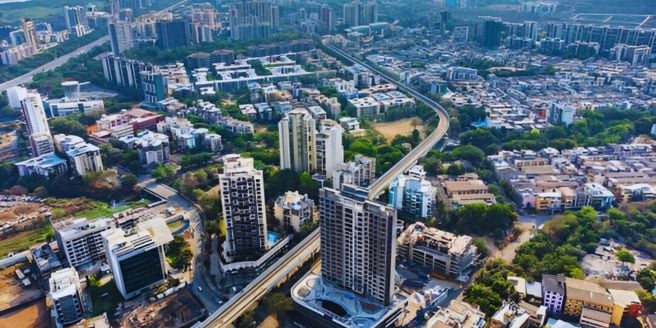
If you have ₹85 L–₹1.6 Cr and you are choosing between Kharghar, Panvel, Vashi, or stretching to Powai — this guide is the honest comparison. Kharghar is the most over-recommended location in Navi Mumbai right now. Sometimes for the right reasons. Sometimes because brokers are coasting on its old story.
Below is the real 2026 picture. Rates verified against 99acres and MahaRERA. Sector-by-sector breakdown. The top developers. Who Kharghar is actually for, and who should look elsewhere.
The 30-Second Summary
- Rate range (April 2026, verified): ₹11,000–18,000 per sq.ft, average ₹17,500/sq.ft. The most expensive Navi Mumbai location outside Nerul-Vashi-Seawoods.
- 2 BHK all-in: ₹95 L on the affordable Kharghar-fringe end, ₹1.62 Cr for premium central sectors.
- Why now: three major infra catalysts unlocked in just over two years — Metro Line 1 (Belapur–Pendhar) live since November 2023, Atal Setu (MTHL) since January 2024, NMIA airport commercial since December 2025. Plus the Kharghar–Turbhe Tunnel (tunnelling complete, December 2028 target) and CIDCO ICP Phase 1 already active. That kind of density is rare for any Indian city.
- The biggest concern I hear: “Has Kharghar already played out?” Short answer: not for end-users. The 5-year appreciation of 24.1% is steady-not-spectacular, but the lifestyle premium per ₹ has not collapsed.
- The one thing I tell every Kharghar buyer: walk Sector 12 vs Sector 35 vs Upper Kharghar in the same afternoon. The price gap will surprise you, and the lifestyle gap explains exactly why.
Why Kharghar Matters in 2026 (the real infrastructure story)
Kharghar sits on the Sion–Panvel highway, between Belapur CBD and the airport zone, in the heart of CIDCO’s master-planned Navi Mumbai. Five years ago it was a credible end-user pick. Today it is a credible end-user pick plus a serious capital-growth play, because of four infrastructure events that landed inside a three-year window:
- Metro Line 1 (Belapur–Pendhar) went operational in November 2023. Pendhar terminal is inside Kharghar. The “metro adjacency” pricing premium that builders have been quoting since 2018 is finally a real, daily commute reality. I cover the on-the-ground impact in how the metro is changing Kharghar real estate.
- Atal Setu (Mumbai Trans-Harbour Link / MTHL) opened January 2024. South Mumbai is now ~50–65 minutes from Kharghar at peak hour. For BKC-Worli professionals, this single bridge changed Kharghar from “second home” to “first home, primary commute”.
- Navi Mumbai International Airport went live for commercial operations in December 2025. Kharghar is roughly 25–30 minutes by road from NMIA. The airport is closer to Panvel and Ulwe (those zones see the bigger price premium), but Kharghar’s spillover effect on rentals and resale velocity is already visible.
- Kharghar–Turbhe Tunnel is through — both breakthroughs landed on 29 June and 31 August 2026 — with viaduct and road work remaining and completion now reported for December 2028. When it opens, Turbhe-Vashi commute compresses by 25–30 minutes. This is the next big rate-mover. Detailed route and timeline in our Kharghar–Turbhe link road guide.
Layered on top: CIDCO’s International Corporate Park (ICP) Phase 1 is active across 120 acres in Kharghar. This is the local employment story. If ICP builds out as planned over 5–7 years, Kharghar finally gets what it has lacked for a decade. A daytime workforce that lives in the same micro-market it works in. I treat ICP as a 5-year tailwind, not a 12-month one. The CIDCO ICP investment guide covers what is built, what is approved, and what is still on paper.
And the EduCity project (Maharashtra government’s planned international education hub on 50 hectares of Kharghar–Owe land, currently at land-levelling stage) is the next layer of demographic anchoring. Schools and universities create resident families. Resident families create resilient end-user demand. That is the long arc.
The Sector Breakdown: Where to Actually Buy in Kharghar
Buyers ask “is Kharghar a good buy?” and I always reply with a question: which Kharghar? The locality is split into clearly different sub-markets and the price gap between them runs 30-50%. The wrong sector at the right rate is still a wrong buy. Here is how I break it down on my desk.
Central Kharghar — Sectors 12, 19, 20, 35
The premium core. Walking distance to Central Park, Utsav Chowk, the railway station, top schools (DPS, Apeejay, NES). Rates run ₹17,500–18,000/sq.ft. 2 BHKs in central Kharghar start around ₹1.25 Cr and go to ₹1.6 Cr+ for premium towers. This is end-user territory — families, MNC professionals, NRIs wanting prestige addresses inside NMR. Lowest resale-velocity risk in the entire Kharghar map.
Sector 35 / Sector 36 corridor
The active new-launch belt. Most under-construction projects on my desk sit in this corridor or its edges — Metro Satyam Codename Waterfalls, Shreeji Space II, Golden Era, Pioneer The Coastal Bay. Rates ₹15,000–17,000/sq.ft for premium under-construction stock. Possession 18–36 months. If you want new construction at a slight discount to central Kharghar, this is your hunting ground. The detailed shortlist is in the top 10 new construction projects in Kharghar guide.
Upper Kharghar — Sector 35E and the airport-corridor pockets
The fastest-growing Kharghar sub-market. Premium emerging neighbourhood with airport-corridor positioning. Rates ₹14,000–16,500/sq.ft — currently 10–15% cheaper than central Kharghar but appreciating faster. Upper Kharghar is its own conversation; I have a dedicated Upper Kharghar guide covering rates, projects, and the airport-effect timeline. If you can stomach a longer possession horizon and want maximum Kharghar appreciation, Upper Kharghar is the pick.
Kharghar fringe — Sector 7, Sector 21, Owe village edge
The cheapest entries that still legitimately count as Kharghar. Rates ₹11,000–13,500/sq.ft. 2 BHK all-in starts around ₹95 L. You trade off walkability to Central Park and access to the marquee schools, but you keep the Kharghar postal code, metro-line proximity, and the resale-velocity advantage of the broader micro-market. For first-time buyers stretching their budget into Kharghar, this is where it works.
For a sector-by-sector ROI ranking, see Kharghar best ROI sectors, and for the full localities map see top localities in Kharghar for real estate investment.
Current Kharghar Property Rates 2026 (verified, with sources)
Here are the numbers I quote buyers as of April 2026. Sources: the 99acres Kharghar rate page, active project filings on the MahaRERA portal, and CIDCO master-plan zoning data on the official CIDCO portal:
| Metric | Value (April 2026) |
|---|---|
| Average rate | ₹17,500/sq.ft |
| Range across sectors | ₹11,000 – ₹18,000/sq.ft |
| 1 BHK all-in (carpet 380–460 sq.ft) | ₹62 L – ₹95 L |
| 2 BHK all-in (carpet 540–720 sq.ft) | ₹95 L – ₹1.62 Cr |
| 3 BHK all-in (carpet 850–1,150 sq.ft) | ₹1.45 Cr – ₹2.40 Cr |
| Year-on-year appreciation | +2.3% |
| 3-year appreciation | +16.7% |
| 5-year appreciation | +24.1% |
The honest read on these numbers: Kharghar’s appreciation curve has slowed since the 2020-2022 sprint. YoY at 2.3% looks weak in isolation. But this is what a mature NMR location looks like. The easy gains are priced in. What you are buying now is steady end-use stability. Compare with Upper Kharghar (faster appreciation, less mature) or Panvel (airport-driven, higher volatility) — different bets, different stages of the curve. For historical context, see the Kharghar property price trends guide and the Kharghar property price guide.
Top Developers Active in Kharghar
Unlike Taloja’s regional-builder dominance, Kharghar has a mix of national-brand developers, established mid-tier names, and high-quality local builders. These are the names I track on my desk:
- L&T Realty — Seawoods Estates and adjacent premium products. Strongest brand-trust signal in NMR. Premium pricing.
- Codename / Satyam group — the most active under-construction name in Sector 35-36. Pre-launch and discovery-pricing specialist. Metro Satyam Codename Waterfalls is currently the highest-traffic Kharghar PDP on our desk. Satyam Codename Mansionz is another active project.
- Shreeji Group — solid mid-budget Kharghar specialist. Two of our top lead-converting Kharghar PDPs are Shreeji Space II and Shreeji Space III.
- Pioneer Group — premium mid-tier with strong amenity packages. Pioneer The Coastal Bay is a current Sector 35-corridor example.
- Bhagwati / Future / Crystal — active mid-budget developers across Kharghar. Bhagwati Avenoir, Future Crystal Corner.
- Krishna / Rachana / Vaman — mid-tier end-user product. Krishna Aura, Rachana Enclave, Vaman Heritage.
- Golden / Neel / NMS / AK Hitech — competitively priced new-launch product. Golden Era, Neel Amplus, NMS One 27, AK Hitech Sapphire.
- Sai Yogi / smaller builders — value-engineering product on the Kharghar fringe. Sai Yogi Sai Residency.
Always cross-check the project’s MahaRERA registration number on the official portal before paying any token. A builder name on a brochure is not a registered project on the regulator’s site — and in Kharghar’s competitive supply environment, that gap is where most disputes start.
For the full Kharghar inventory, browse our listings: all Kharghar properties for sale, new residential projects in Kharghar, or under-construction Kharghar projects. For premium-end stock, see luxury homes in Kharghar.
Connectivity & Commute (the realistic 2026 times)
Brochures love drive times that assume empty roads. Here are the realistic 2026 numbers I quote, measured at peak hours from central Kharghar:
| From central Kharghar to | Mode | Realistic peak time |
|---|---|---|
| Belapur CBD | Metro Line 1 (operational since Nov 2023) | 20–25 min |
| Vashi (APMC) | Car | 30–40 min |
| Panvel Junction | Car | 20–25 min |
| NMIA airport | Car | 25–30 min |
| South Mumbai (Nariman Point) via Atal Setu | Car | 50–65 min |
| BKC via Atal Setu | Car | 45–55 min |
| Powai / Hiranandani | Car | 60–75 min |
| Thane | Car (post Kharghar–Turbhe Tunnel: ~20 min faster) | 50–60 min today |
| Mumbai Airport (BOM) | Car (less critical now with NMIA live) | 60–80 min |
| Pune (Hinjawadi) | Sion–Panvel + Mumbai–Pune Expressway | 2–2.25 hrs |
The Belapur CBD number is the one that matters most for the daily-commute end-user buyer. The Atal Setu BKC number is what unlocks Kharghar for the Mumbai-shifter family. The NMIA number is what differentiates Kharghar from Thane or Mira Road for an NRI looking at “near the new airport”. Each of these times is a buyer profile I see every week.
Schools, Hospitals & Daily Life
Kharghar’s daily-life infrastructure is its single biggest non-price differentiator from Panvel and Taloja. This is the engine of its lifestyle premium.
Schools (within central Kharghar)
- DPS Kharghar — premium CBSE option, the marquee school in NMR
- Apeejay School — Sector 21
- Ryan International — Sector 11
- NES International — Sector 19
- Podar International — Sector 12
- Yogi Sabha Vidyalaya — for ICSE
For higher education, NMIMS Kharghar campus and the upcoming EduCity hub anchor the academic story. Top coaching for JEE/NEET (Allen, Aakash, Bansal) all have Kharghar centres.
Healthcare
- Tata Memorial Hospital, Kharghar — the marquee tertiary-care institution. National-level cancer centre. Single biggest healthcare brand in NMR.
- MGM Hospital Kharghar — Sector 1, multi-specialty
- Apollo Diagnostics + Apollo Pharmacy network — multiple branches
- Sigma Hospital — Sector 8
- Lifeline Multispeciality — Sector 35
This is one of the under-discussed reasons families pay the Kharghar premium. Tata Memorial alone is worth ₹500-700/sq.ft of perceived value. From Panvel or Taloja, you would commute to Kharghar for the same care anyway — better to live closer.
Daily life: parks, shopping, food
Central Park, Kharghar — one of the largest urban parks in Asia, sprawling across multiple sectors. This is the lifestyle anchor that no other NMR location can match. Mall-grade shopping is at Little World Mall, Glomax, and the high street around Utsav Chowk. Inorbit Vashi (15 min) and Seawoods Grand Central (20 min) cover bigger retail. The food scene around Sector 12 and Utsav Chowk is the most diverse in NMR outside Vashi-Nerul.
Buyer Profiles I See Every Week
To make this concrete, here are the four buyer types who actually close in Kharghar month after month. If you do not see yourself in one of these, that is also useful information — Kharghar may not be your market.
1. The MNC-professional family (₹1.1–1.6 Cr budget)
Couple in their mid-30s, both working at MNCs in BKC, Powai, or Worli, combined income ₹35–60 LPM. One or two children. Want top schools (DPS, Apeejay), Tata Memorial in case anyone needs it, and a 3 BHK they can grow into. Central Kharghar Sectors 12, 19, 20, 35 hit this brief precisely. Roughly 40% of my Kharghar closures.
2. The end-user upgrade (₹85–1.1 Cr budget)
Family currently in a 1 or 2 BHK in Vashi/Nerul rental, or a smaller flat in Andheri. Wants to own a 2 BHK in a marquee NMR location without paying Vashi-Nerul rates. Sector 35-36 corridor or Upper Kharghar fits. Often the wife works in Belapur or Vashi, husband commutes to Mumbai via Atal Setu.
3. The Upper-Kharghar capital-growth investor
NRI or HNI patient capital, 5–7 year horizon, wants Kharghar’s lifestyle credentials with airport-corridor appreciation kicker. Allocates ₹1.0–1.4 Cr per unit, often two units. The Upper Kharghar guide covers this thesis in detail.
4. The first-time-into-Kharghar buyer (₹95 L–1.1 Cr stretch budget)
Couple stretching budget to enter Kharghar at the fringe — Sector 7, Sector 21, the Owe village edge. Trade-off: smaller carpet area or further from Central Park, in exchange for keeping the Kharghar postal code. This profile is growing fastest in 2025-2026 because of MTHL+metro accessibility unlocking the daily commute.
Investment vs End-Use: An Honest Thesis
I do not believe in selling Kharghar as a “next BKC” story — that line gets recycled in every other NMR brochure. The honest case is more layered:
- For end-users: Kharghar gives you the highest lifestyle-per-rupee inside NMR — Tata Memorial, top schools, Central Park, metro, multiple connectivity options. The 2.3% YoY appreciation looks weak, but you are buying lifestyle stability, not capital growth. If you plan to live in the home for 7+ years, the trade is favourable.
- For pure investors (capital appreciation): central Kharghar is mature; appreciation is steady at 2-3% YoY. Upper Kharghar and the airport-spillover sectors are where 2026-2030 appreciation kicker lives. Pre-launch in Sector 35E or the airport corridor with a 5-year horizon is the highest-leverage Kharghar move.
- For rental-yield investors: Kharghar 2 BHK rentals run ₹35,000-55,000/month in central sectors. On a ₹1.25 Cr 2 BHK that is ~3.5-4% gross yield — better than Vashi-Nerul (2.5-3%) but lower than Panvel-Taloja (4-5%). Decent, not exceptional.
- For NRIs: Kharghar is the safe NMR play under ₹2 Cr. Lower volatility than Panvel/Ulwe airport plays, better lifestyle than Taloja, more inventory than Nerul/Seawoods at a friendlier price. For airport-adjacency premium, Panvel and Pushpak Nagar (Ulwe) are stronger; for premium prestige, Nerul/Seawoods are the answer; for balanced NMR exposure, Kharghar.
For sector-level ROI ranking, the Kharghar best ROI sectors guide breaks it down. For a wider NMR comparison, see Kharghar vs Navi Mumbai and Nerul vs Kharghar.
Pros & Cons of Living in Kharghar (Honestly)
I have walked Kharghar for years with buyers, and the honest answer is the same every time: this is a top-tier end-user location if the trade-offs match your life. Here are the real positives and the real negatives.
The pros that actually hold up
- The green canopy. Central Park, Pandavkada hills on the horizon, sector-level greenery — Kharghar is genuinely one of the greener urban pockets in MMR. This is not marketing.
- Affordability against Mumbai (still). A 2 BHK that costs ₹3.2-4 Cr in Andheri or Powai costs ₹1.1-1.4 Cr in Kharghar with comparable build quality. The gap closed somewhat over 2020-2025 but it has not collapsed.
- Infrastructure depth. Metro Line 1 + Atal Setu + NMIA + tunnel + ICP + EduCity is the densest 18-month infra story of any Indian sub-market right now. Each project on its own would be material; together they are transformative.
- Schools and healthcare. Covered above. The single biggest reason families with school-age children pay the Kharghar premium.
- Mature, mixed community. First-generation Mumbai shifters, MNC families, NRI investors, locals who have been here since CIDCO mass housing. Diverse, settled, not a brand-new pre-launch ghost town.
The cons buyers under-estimate
- The commute is “much better” — not “easy”. Atal Setu helps. Metro Line 1 helps. But peak-hour to Mumbai is still 50-65 minutes in a car or a 2-leg metro+local journey. For someone whose office is in BKC and who values 25-minute commutes, Kharghar still does not deliver that.
- Limited nightlife and Mumbai-grade entertainment. Cafés, pubs, multiplexes — fine. Mid-week DJ nights, niche restaurant scene, late-night lounges — sparse. If you are in your late 20s and value Bandra’s energy, Kharghar will feel suburban.
- Water supply edge cases. Some Kharghar sectors and project pockets have intermittent supply pressure during summer months. Always ask the society about water tanker dependence before booking — this is one of the under-discussed practical issues.
- Appreciation has slowed. The 2018-2022 sprint is over. YoY at 2.3% is the new reality. If you bought in 2018 expecting Kharghar to compound at 12% forever, you have already adjusted; if you are buying now expecting a 2018-style ride, recalibrate.
- Construction dust and ongoing noise. Many sectors are still seeing active construction. Tunnel, coastal road, ICP build-out, new towers — until 2027-2028, parts of Kharghar will look and feel “in progress”. Plan around this if you have small children or you work from home.
For a deeper rent-vs-buy framework specific to Kharghar, see the buying vs renting in Kharghar guide.
Kharghar vs Panvel vs Taloja vs Upper Kharghar — the Comparison Table
Buyers shortlisting Kharghar usually also look at Panvel (airport zone), Taloja (affordability), or stretch to Vashi-Nerul (premium). Here is the head-to-head, all numbers verified April 2026 against 99acres rate pages:
| Location | Avg ₹/sq.ft | 2 BHK all-in | 5-yr appreciation | Killer infra | Best for |
|---|---|---|---|---|---|
| Kharghar | ₹17,500 | ₹95 L–1.62 Cr | +24.1% | Metro 1 + MTHL + Tata Memorial + Tunnel | End-users wanting top-tier NMR lifestyle |
| Panvel | ₹13,800 | ₹75 L–1.19 Cr | +30.5% | NMIA + MTHL | Mid-income end-users, NRIs targeting airport zone |
| Taloja | ₹8,700 | ₹48–72 L | +22% | Metro 1 fringe + Metro 12 (upcoming) | First-time buyers, MIDC employees, budget-conscious |
| Upper Kharghar | ₹14,850 | ₹89 L–1.40 Cr | est. +32% | Airport corridor + Kharghar lifestyle adjacency | Capital-growth investors with patience |
Read this table as: Kharghar is the lifestyle-and-stability play; Panvel/Ulwe is the airport-momentum play; Taloja is the affordability-and-MIDC play; Upper Kharghar is the appreciation-with-Kharghar-DNA play. Different bets, different stages of the cycle.
Hidden Costs & the Realistic All-In Math
Brochure prices tell a partial truth. Here is the math I work through with every buyer for a ₹1.25 Cr “sticker” 2 BHK in central Kharghar:
| Line item | Typical amount |
|---|---|
| Sticker price (sale agreement) | ₹1,25,00,000 |
| + Stamp duty (5% female-buyer / 6% standard, Maharashtra) | ₹6,25,000 – ₹7,50,000 |
| + Registration (1%) | ₹1,25,000 |
| + GST (5% on under-construction without ITC) | ₹6,25,000 |
| + Society maintenance deposit (12–24 months upfront) | ₹1,00,000 – ₹2,00,000 |
| + Parking (extra in many premium Kharghar projects) | ₹3,00,000 – ₹6,00,000 |
| + Floor-rise / preferred-location charges | ₹2,00,000 – ₹5,00,000 |
| + Brokerage (where applicable, 1–2%) | Often waived with Revaa |
| Realistic all-in | ₹1.45–1.53 Cr |
That is roughly 16-22% on top of the sticker. Build the buffer in before you sign. Many first-time Kharghar buyers exhaust their savings on booking and registration. Then they come up short on parking, society deposit, or interior fit-out. This is one of the most common Kharghar stress points I see at my desk.
The 5 Mistakes I See Kharghar Buyers Make
- Buying the brochure’s metro-adjacency claim without walking the route. “Walking distance to Metro Line 1” can mean 3 minutes or 18 minutes. Walk it before you sign.
- Trusting the brochure’s possession date as gospel. Add 6–12 months as a default buffer. Cross-check the legally binding date filed on MahaRERA’s portal.
- Underestimating the all-in cost. See the math above. The 16-22% gap between sticker and all-in is where deals fall apart in Kharghar’s higher-priced market.
- Choosing Sector 35-36 because it is “newer” without checking water and parking. Some new towers in this corridor have known water-supply pressure issues during peak summer, and parking allocations are tight. Verify before booking.
- Stretching to central Kharghar when the fringe sectors give 80% of the value at 70% of the price. If your budget is ₹95 L–₹1.1 Cr, do not force yourself into a sub-optimal Sector 35 tower when Sector 7 or Owe-edge gives you a better unit. Postal code prestige is real but bounded.
For new-construction shortlists, the top 10 new construction projects in Kharghar guide and resale vs new flat in Kharghar walk the practical decision framework.
Frequently Asked Questions
Is Kharghar a good investment in 2026?
For end-users with a 7+ year horizon, yes. Kharghar gives you the strongest lifestyle-per-rupee inside Navi Mumbai. Appreciation is steady at 2-3% YoY. Major infrastructure is already delivered — Metro Line 1, Atal Setu, NMIA, Tata Memorial. For pure capital growth in a 3-5 year window, Upper Kharghar or Panvel will move faster because of airport-corridor positioning.
What is the average price of a 2 BHK flat in Kharghar?
As of April 2026, a 2 BHK in Kharghar runs ₹95 L on the affordable fringe (Sectors 7, 21, Owe edge). Premium central sectors (12, 19, 20, 35) reach ₹1.62 Cr. Average rate is ₹17,500 per sq.ft. Add 16-22% for stamp duty, GST, registration, parking, and society deposits to get a realistic all-in figure.
Which is the best sector to live in Kharghar?
Sectors 12, 19, 20, and 35 are the premium core — best for families with school-age children and walking access to Central Park. Sector 35-36 corridor is the active new-launch belt for buyers wanting under-construction stock. Upper Kharghar (Sector 35E and airport-corridor pockets) is the fastest-appreciating sub-market. Sector 7, Sector 21, and the Owe edge are the value-buy fringe with Kharghar postal code preserved.
Is the Kharghar–Turbhe Tunnel operational?
Not yet. Both tunnel breakthroughs were achieved on 29 June and 31 August 2026; viaduct and road work remain, with completion now reported for December 2028. Once operational, Kharghar–Turbhe and Kharghar–Vashi commute compresses by 25-30 minutes. Treat any pre-launch project pricing itself on tunnel-adjacency as carrying timeline risk until 2028.
How does Kharghar compare to Panvel for first-time buyers?
Kharghar is more expensive (₹17,500 vs ₹13,800 average) but offers stronger lifestyle infrastructure — Tata Memorial, top schools, Central Park, metro. Panvel is the better airport-momentum play. NMIA adjacency drives faster appreciation, and prices are significantly cheaper. For a first-time buyer with a ₹1 Cr budget, Kharghar fringe sectors and Panvel central are the two realistic options. Choose based on whether lifestyle stability or capital appreciation matters more.
Is the Kharghar appreciation already over?
For central Kharghar — largely yes. The 2018-2022 sprint priced in the easy gains. YoY at 2.3% reflects a mature market. For Upper Kharghar and the airport-corridor pockets — no, those are still in the appreciation phase. Expect 6-9% YoY through 2025-2030 as infrastructure milestones land (NMIA scaling, ICP build-out, EduCity progress, tunnel completion).
What documents should I check before booking a Kharghar flat?
Non-negotiable: MahaRERA project registration number (verify on the official portal), commencement certificate, occupancy certificate (for ready possession), title clearance, CIDCO NOC where applicable, and an unencumbered chain of ownership. For under-construction projects, the legally binding possession date is the one filed in the RERA filing — not the brochure date. For premium-end purchases above ₹1.5 Cr, always engage a property lawyer for the final title and encumbrance check.
How to Approach Kharghar in 2026 — My Honest Take
If you are reading this guide, you are probably weighing Kharghar against three or four alternatives — Panvel, Upper Kharghar, Vashi-Nerul, maybe stretching to Mumbai. The honest framing I would offer is this: do not buy Kharghar because everyone keeps recommending it. Buy Kharghar because the lifestyle layer it delivers — schools, healthcare, parks, metro, multiple commute options — is not replicable inside NMR at any other price point. That is the case Kharghar makes. It is not a “next BKC” story; it is a “best balanced end-user location in NMR” story, and that has not changed.
Take a Saturday and walk three projects across central Kharghar, Sector 35-36, and Upper Kharghar. Then take a Tuesday at 8 PM and revisit the one you liked best. Talk to two existing residents in each. Most importantly — sit down and run the all-in math on at least two of them before you fall in love with one.
And then call us. We do not push projects on commission targets. We walk the shortlist with you, run the math honestly, and tell you when to skip a project we ourselves have on the wall. That is how you end up with a Kharghar home that holds its value while you live in it. Reach out when you are ready.
Last verified: April 2026. Deeper dives on specific Kharghar sub-topics:

